



Golf 101: Terminology & Scoring Basics
?fmt=auto)
When you first step onto the course or into a golf shop, it can feel like everyone is speaking a different language. From understanding the parts of your club to knowing the difference between a birdie and a bogey, learning golf terminology is the first step toward enjoying the game. Our Golf Experts explain the basics to help you feel confident when talking about your gear and your score.
Part 1: Your Tools—Understanding Club Anatomy
Understanding the makeup of a golf club helps you understand how it affects your shot. You are legally allowed to carry up to 14 clubs in your bag. See our article on the types of golf clubs to learn more about which clubs are included in a set.
Basic Club Anatomy
A golf club is primarily made up of three main parts:
-
Head: The part that strikes the ball.
-
Shaft: The long, slender tube connecting the grip to the head.
-
Grip: The top part of the club where you place your hands.
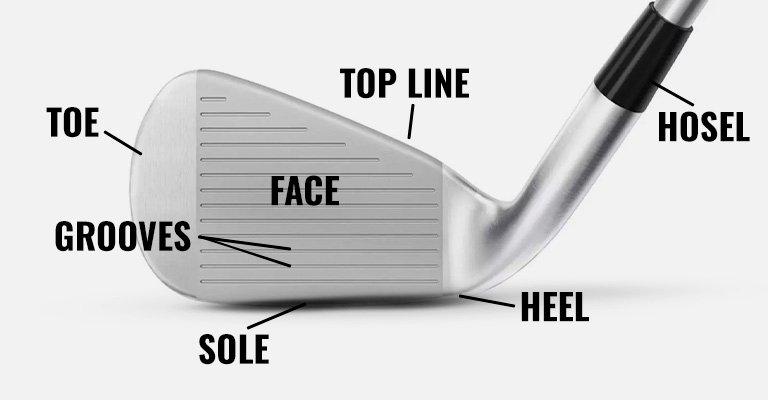
Parts of a Club Head
The head itself contains these essential components, which apply to every club—driver, iron, or wedge:
-
Face: The part of the club that directly contacts the ball.
-
Grooves: These are the scored lines cut into the club face (especially on irons and wedges) that help grip the ball and channel away moisture and debris.
-
Hosel: This is the section where the club's shaft meets the head.
-
Toe: The very end of the club face.
-
Heel: The part of the club face closest to the shaft (opposite the toe).
-
Sole: The bottom of the club head. This is the part that rests on the ground.
-
Top Line: The upper edge of the club face, opposite the sole.
What is Loft?
Loft is the degree of upward angle on the club face. The more loft a club has, the higher the ball will launch. For example:
-
Your driver (used for maximum distance) typically has eight to 13 degrees of loft.
-
A 3-wood usually ranges from 13 to 17 degrees of loft.
-
A 5-wood usually ranges from 17 to 21 degrees of loft.
Related Expert Content | What is the Loft of a Golf Club?
Part 2: The Swing, Launch & Ball Flight
Swing Speed and Shaft Flex
Your swing speed is the speed of the club head as it hits the ball. This speed determines the type of shaft flex you should use for maximum performance. Note that the recommended shaft flex for drivers and woods is different than for irons.
Driver & Wood Shaft Flex Chart
| Club Head Speed (Miles Per Hour) | Recommended Shaft Flex |
|---|---|
| 80 or Slower | Light Flex (often called Ladies or Senior flex) |
| 80 to 95 | Regular Flex |
| 95 to 105 | Stiff Flex |
| 105 and Above | Extra Stiff Flex |
Iron Shaft Flex Chart
| Club Head Speed (Miles Per Hour) | Recommended Shaft Flex |
|---|---|
| 72 or Slower | Light Flex (often called Ladies or Senior flex) |
| 72 to 83 | Regular Flex |
| 84 to 96 | Stiff Flex |
| 96 and Above | Extra Stiff Flex |
Understanding Ball Flight
Launch is the angle at which the ball leaves the club face. When you look at the trajectory, the resulting flight path is key to diagnosing your swing.
Controlled Shots (Intentional):
-
Straight Shot: The ball doesn't move left or right.
-
Draw: A slight, controlled right-to-left curve.
-
Fade: A slight, controlled left-to-right curve.
Erratic Shots (Unintentional):
-
Hook: An aggressive, accidental right-to-left curve.
-
Slice: An aggressive, accidental left-to-right curve (the most common shot you hear about in the shop).
Note for Left-Handed Golfers: The direction of the draw/fade and hook/slice is the opposite. For a left-handed golfer, a draw is a slight, controlled left-to-right curve, and a slice is an aggressive right-to-left curve.
Part 3: The Scorecard—Definitions & Handicap
Unlike most sports, success in golf is determined by the lowest score, or the fewest number of shots taken.
Scoring Terminology
The par is the predetermined number of strokes a skillful (or zero handicap) golfer should take to complete a hole. All other terms are relative to par:
-
Birdie: One stroke less than par (1-under par).
-
Eagle: Two strokes less than par (2-under par). This is typically achieved on a par-five hole.
-
Hole-in-One (Ace): Occurs when the golfer holes the ball on the tee shot.
-
Bogey: One stroke more than par (1-over par).
-
Double Bogey: Two strokes more than par (2-over par).
-
Albatross (Double Eagle): Three strokes less than par (3-under par). This is extremely rare and happens when you hole out on a par-five in two shots.
-
Other: Any score worse than a double bogey.
Handicap Explained
A handicap is a measurement of your playing ability compared to par. It uses a formula to relate your average score to the course's par.
For example, if you average a score of 88 on an 18-hole course that is par-72, your handicap is 16 (88 - 72 = 16).
The handicap system levels the playing field in competitive play:
Example: If you are a 16 handicap and your opponent is a one handicap, you would receive 15 shots to even the field. This allows golfers of all skill levels to play together fairly.
Part 4: Common Course Terms
When you're out on the course, you'll hear these terms used often:
-
Tee Box: The designated area where you start the hole and hit your drive (first shot).
-
Fairway: The well-maintained, short-grass area between the tee box and the green.
-
Green: The area of very finely cut grass where the hole is located. You will use a putt (a light stroke along the ground) here.
-
Rough: The longer, thicker grass areas that border the Fairway.
-
Bunker/Sand Trap: A specific hazard filled with sand.
-
Lie: This refers to the position of your ball on the ground (e.g., a good lie in the fairway or a bad lie in the rough).
-
Fore: A crucial piece of etiquette. This is shouted loudly to warn other players that a ball is heading in their direction.





Understanding the terminology and the role of your gear is the foundation of a great round. If you have questions about your swing speed or need help understanding which clubs are right for you, visit us at your nearest SCHEELS or schedule a custom golf club fitting. Our Golf Experts are ready to help you find the right fit.