


How to Choose a Rifle Scope
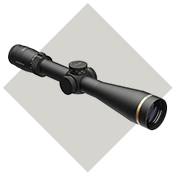
Whether you’re hunting a trophy buck or practicing your aim, there’s no doubt having the right rifle scope to improve accuracy is important, but if you’re new to optics, navigating complex terms can easily get overwhelming. Our Optics Experts highlight important features to consider when buying a rifle scope including the parts of a scope, how to read the numbers associated with a scope, understanding eye relief, and more.
1. Understand the Parts of a Scope
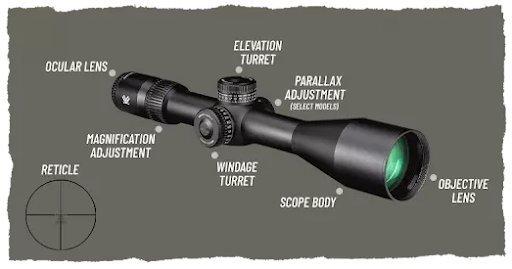
It’s important to get a basic understanding of the parts of a scope so that you can understand how the scope functions.
-
Objective Lens: This is the lens that’s at the front of the scope (closest to the target). This lens absorbs and focuses the light to create a clear image. The size of the objective lens affects the amount of light a scope can gather, which will impact the brightness and clarity of the image, especially in low-light conditions.
-
Ocular Lens: This is the lens that’s at the rear of the scope (closest to your eye). It allows you to see the reticle and target clearly and is important for achieving proper eye relief and comfort.
-
Reticle: This is the crosshair or aiming point within the scope to help you align your shot. There are several different types of reticles to choose from, placements (FFP vs. SFP), and units of measurement (MIL vs. MOA).
-
Windage Turret: This is a knob or dial that adjusts the scope horizontally (left or right). This helps you adjust for wind drift or misalignment for a more accurate shot. These adjustments are measured in MOA or MIL.
-
Elevation Turret: This is a knob or dial that adjusts the scope vertically (up or down). This helps you adjust for bullet drop over distance. These adjustments are also measured in MOA or MIL.
-
Diopter: This adjusts the ocular lens to focus the reticle to suit your vision.
-
Scope Body/Tube: Made from durable materials, the scope body protects all internal components from moisture, dust, and impact.
-
Parallax Adjustment: This focuses the target image at various distances to avoid parallax errors (the object appearing to shift when your point of view changes).
-
Magnification Adjustment: This allows you to change the level of magnification of the scope for more flexibility.
2. Understand the Numbers on a Rifle Scope
When looking for a new rifle scope, you’ll notice they are described by a set of numbers such as 3-9x40 or 10x42. These numbers indicate the level of magnification and the objective lens diameter.
Rifle Scope Magnification
The first number on a scope indicates the magnification power, or how many times larger an object will appear compared to viewing with the naked eye. These numbers can range from 1x to 16x (or higher).
There are two types of scope magnifications: variable power and fixed power.
-
Variable Power: These scopes have an internal mechanism to adjust the magnification power within a specific range. For example, the Vortex Crossfire II 3-9x40 BDC MOA Rifle Scope offers a magnification range from 3x to 9x.
-
Fixed Power: These scopes stay at the same magnification power. They are less versatile, but some hunters prefer fixed power scopes because they require fewer adjustments. For example, a 12x44 scope provides a magnification of 12x.
Objective Lens Diameter
The number after the x on a scope indicates the objective lens diameter in millimeters. The larger the objective lens diameter, the more light the scope gathers, creating a brighter image. Most hunters will want an objective lens of 32mm to 44mm, since this provides a good balance between brightness and image quality.
Expert Advice | If you plan to shoot at long range, it’s best to have a 50mm or greater objective lens so that you can use a higher magnification. Also, if you plan on hunting or shooting at dusk, dawn, or other low-light conditions, the added light-gathering power of a larger objective lens can make your image brighter relative to the conditions.
Magnification’s Impact on Field of View (FOV)
Field of View (FOV) is the width of the area you can see through the scope at a specific distance and is typically measured at 100 yards. As magnification increases, the field of view decreases. This means that at higher magnification levels, you’ll see less of the area around your target, which can make tracking moving targets more difficult.
3. Determine the Type of Reticle
There are several different types of reticles to match the range of conditions and situations hunters and target shooters encounter. Each brand labels its reticle design differently, but there are general classifications for the type of reticle. It comes down to how you plan to use your rifle scope, what’s your application? You can even find illuminated reticle options to give you an advantage in low-light conditions.
Choosing a Reticle Measurement
Aside from choosing the type of reticle, you’ll also need to select your preferred unit of measurement—milliradians (MIL) or minutes of angle (MOA). With these measurements, you can make the necessary adjustments to hit the target.
Need more guidance? Our Optics Experts cover everything you need to know about these units of measurement: MIL vs. MOA—Understanding the Differences >
4. Choose between FFP & SFP
First Focal Plane (FFP) and Second Focal Plane (SFP) refer to the placement of the reticle within the scope. The placement impacts how the reticle appears when adjusting the magnification.
-
FFP: The reticle grows with increased magnification.
-
SFP: The reticle stays the same size, regardless of the magnification level.
Need more guidance? Our Optics Experts cover everything you need to know about the differences between the first focal plane and second focal plane: FFP vs. SFP: Understanding the Difference >
5. Type of Turrets
When using a rifle scope, you want to be able to adjust your aim horizontally and vertically to compensate for bullet drop (elevation) and wind drift (windage). Rifle scopes can feature capped turrets or exposed turrets. Choosing between the two depends on your application and preferences.
-
Capped Turrets: These turrets are covered by a protective cap to prevent accidental adjustments when in the field.
-
Exposed Turrets: These are typically found on long-range or tactical scopes. They are designed for quick, easy adjustments in the field and often feature audible clicks for precise dialing. They are ideal for situations where frequent adjustments are needed like in competitive shooting.
6. Eye Relief
Eye relief is the distance the scope should be from your eye for optimal viewing. For example, if a scope has an eye relief of four inches, the eyepiece lens should be four inches from your eye when aiming down the scope. Most rifle scopes have an eye relief between three and four inches and are great for hunting.
Rifle Scope Eye Relief Chart
| Type of Firearm | Ideal Eye Relief Range |
|---|---|
Common Hunting Rifles (.243, .270, etc.) | 3 to 4 in. |
High-Powered/Heavier Rifles, Slug Shotguns | 4 to 5 in. |
Rifles with Heavy Recoil | 5 to 6 in. |
7. Tube Size
The tube size refers to the circumference of the scope housing. There are two common diameters—1 inch and 30mm. The size of the tube is important because it influences how much internal adjustment (for windage and elevation) is available and how the scope is mounted.
-
1 inch (25.4mm): This is the most common size and is ideal for hunting. It’s lightweight and compact.
-
30mm: This size is more common for tactical and long-range scopes and offers more room for windage and elevation adjustments. It does require 30mm rings for mounting.
8. Lens Coatings
The glass used in rifle scope lenses is treated with a variety of coatings to help reduce glare and fogging as well as protect them from damage.
-
Single-coated lenses have an anti-reflective coating applied to one surface of one lens.
-
Fully-coated lenses have one layer of coating applied to both surfaces of all lenses.
-
Multi-coated lenses have at least one lens with multiple layers of coatings and may have other lens surfaces with one layer of coating.
-
Fully multi-coated lenses have multiple layers of lens coating on all surfaces of all lenses. These usually offer the clearest, most detailed image.
9. Parallax Adjustment
Parallax is the apparent shift of the reticle in relation to the target as your eye moves. Parallax adjustment on a rifle scope ensures that the reticle stays in line with the target at different distances. This helps reduce the chance of misalignments, especially at long ranges. While not all rifle scopes include this feature, it is common in high-magnification and long-range scopes.
10. Durability
There are several weather conditions that you’ll encounter when on the hunt, and your rifle scope needs to be durable. Look for specific features like waterproof, fog-proof, and shockproof as well as durable materials including aircraft-grade aluminum.
Choosing the right rifle scope is a critical step whether you’re preparing for a hunting trip or practicing at the range. By understanding the technical features and components, you can find the best rifle scope to fit your needs whether it’s from Vortex, Leupold, Zeiss, or another trusted optics brand. If you have additional questions about how to choose a rifle scope, stop into your local SCHEELS to speak with an Optics Expert.