



Choosing a Spinning Reel
Spinning reels are on of the most popular types of reels because of their versatility and efficiency. While this versatility is a great asset, it also means there’s a wide array of spinning reels available. To help you choose the right spinning reel for your style of fishing, our Fishing Experts explain what to look for in a spinning reel including gear ratio, reel size, and more.
Parts of a Spinning Reel
Before choosing a spinning reel, make sure you understand the components and design of the reel. This allows you to compare reel features and specifications to find the right reel for you.
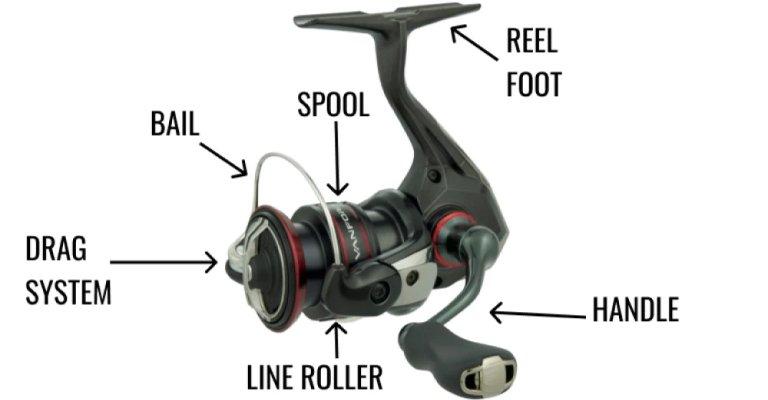
-
The reel foot is the part of the reel that attaches to the rod.
-
The spool is what the line is wrapped around. Line is wound around the spool and through the line roller, which is what around the spool to reel the line back in when the handle is rotated. The bail acts as the gate for the line. When the bail is closed (as in the diagram above), the line will not be unwound from the spool. When the bail is opened (“flipped up”), line can be released from the spool.
-
The drag system automatically controls line tension to prevent breakage and can be adjusted using the dial on top of the spool.
Spinning Reel Gear Ratio
An important consideration when choosing a spinning reel is the gear ratio, or the number of times the bail rotates around the spool in a full revolution of the handle.
- For example, if a spinning reel has a gear ratio of 5.2:1, the bail will rotate around the spool 5.2 times for every 360 degree turn of the handle.
It’s important to match your gear ratio to your application sot that you can better present your lure.
Spinning Reel Gear Ratio Chart
Generally, gear ratios fall into three categories: slow (ratios below 6:1), medium (ratios between 6:1 and 7:1), and fast (ratios above 7:1).
| Gear Ratio | "Speed" | Application |
|---|---|---|
| <6:1 | Slow | Diving crankbait, deep spinnerbait, swimbaits |
| 6:1—7:1 | Medium | Shallow spinner baits, crankbaits, medium-depth cranks |
| >7.1 | Fast | Jigging, Texas rigs, jerk baits, lipless crankbaits, topwater lures |
Spinning Reel Size
A second key feature to consider when choosing a spinning reel is the size of the reel because this affects casting distance and power. Your target species will influence your reel’s size—the larger the species, the larger the reel.
Spinning Reel Size Chart
Keep in mind that the size may be listed differently depending on the brand: a size 10 reel is the same as a size 1000, a size 25 is the same as a size 2500, and so on.
| Reel Size | Target Species |
|---|---|
| 10–20 | Crappie & panfish |
| 25–35 | Bass, walleye, Northern pike |
| 40–55 | Catfish, muskie |
Expert Tip | While this size chart is a great place to start, you’ll also want to make sure the reel is rated for the line you plan to use by checking the reel’s line capacity.
-
For example, a reel with a mono line capacity of 6/200 is rated for 200 yards of 6 lb monofilament line.
-
Need help choosing a fishing line? Check out our fishing line guide and find the right line weight for your target species.
Spinning Reel Drag
After you’ve chosen the right size and gear ratio, you’ll want to consider the drag system. On spinning reels, drag applies a set tension to hooked fish and lets out line if the fish exceeds the drag setting. This system avoids sudden or excess stress on the line, preventing breaks and lost fish. The drag on a spinning reel can be adjusted by rotating the dial on top of the spool, allowing anglers to set the tension applied to fighting fish.
When shopping for a spinning reel, you’ll often see reels with sealed drag systems. A sealed drag is exactly what it sounds like: the plates that create the “drag’ are contained within a waterproof housing. Sealed drags protect the system from the elements and wear to ensure continued smooth performance.
Anti-Reverse
Anti-reverse is a common feature on spinning reels that prevents anglers from reeling backwards. If the reel has an anti-reverse switch, this setting can be turned on and off. When the anti-reverse is engaged, the handle can only rotate one way—to retrieve line. Line will only be let out if the bail is open or the drag is engaged. When anti-reverse is off, the angler can reel backwards to let out line, also called “back-reeling”
While modern drag systems work extremely well for most anglers, those fishing with lighter lines may benefit from an anti-reverse switch. If you hook a larger fish than expected with a light line, back reeling allows you to quickly adjust the tension and prevent a break. Many spinning reels include an anti-reverse switch, but it’s often only used by serious anglers—the majority of anglers will be fine to rely on the drag.
Ball Bearings
Most fishing reels have ball bearings: spherical components that reduce friction and allow a reel to spin quickly and more smoothly. When choosing a spinning reel, you’ll often see the ball bearings listed as a number plus another number, for example 4+1. This indicates the number of ball bearings and the number of roller bearings in the reel: a 4+1 reel has four ball bearings and one roller bearing.
Most anglers should choose a spinning reel with at least four or five ball bearings (the first number—do not count the roller bearing). While more ball bearings technically make the reel feel smoother, having fewer but higher quality bearings will give you much better results than many cheaper bearings. High-quality bearings will last much longer and keep the reel smooth and efficient for years to come. Some ball bearings are also shielded, which means they are protected on the side by discs for even more durability.
With the right spinning reel for your target species and fishing style, you’ll be prepared for success on the water. If you have any questions about choosing a spinning reel, stop by your local SCHEELS and talk to one of our Fishing Experts.